


Page 100 - LIT-18626-15-33
P. 100
SportsBoat_F6A12.book Page 89 Thursday, May 30, 2024 4:19 PM
Operation and handling requirements
use. Yamalube oils take full advantage of the on page 123 for information on supplying
base oil’s qualities and blend in the ideal bal- water.)
ance of additives to make sure the final oil When checking the engine oil level on wa-
clears our performance standards. Thus, ter, moor the boat so that it will not drift
Yamalube mineral, semisynthetic and syn- away.
thetic oils have their own distinct characters
and value. Yamaha’s experience gained over To check the engine oil level:
many years of research and development (1) With the engine stopped, place the boat
into oil since the 1960’s helps make in a precisely level position on land or
Yamalube the best choice for your Yamaha launch the boat.
engine. (2) Look in all directions, and then start the
engine. (See page 107 for information on
starting the engine.)
(3) Run the engine at idling speed for 6 min-
utes or more. Run the engine an addi-
tional 5 minutes if the ambient
temperature is 20 °C (68 °F) or less.
(4) Stop the engine.
(5) Open the engine hood. (See page 66.)
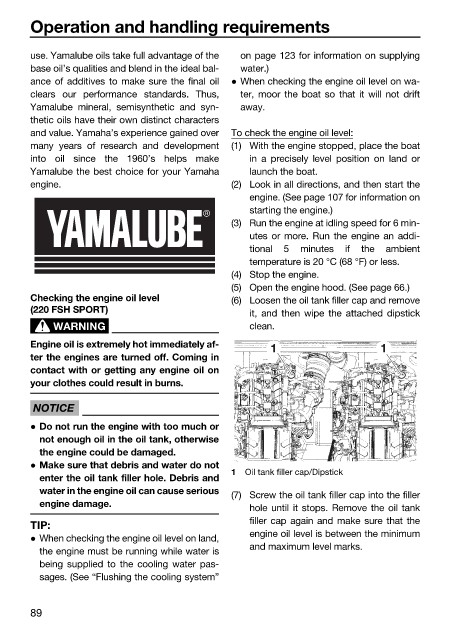
Checking the engine oil level (6) Loosen the oil tank filler cap and remove
(220 FSH SPORT)
it, and then wipe the attached dipstick
WARNING clean.
Engine oil is extremely hot immediately af- 1 1
ter the engines are turned off. Coming in
contact with or getting any engine oil on
your clothes could result in burns.
NOTICE
Do not run the engine with too much or
not enough oil in the oil tank, otherwise
the engine could be damaged.
Make sure that debris and water do not
1 Oil tank filler cap/Dipstick
enter the oil tank filler hole. Debris and
water in the engine oil can cause serious
(7) Screw the oil tank filler cap into the filler
engine damage.
hole until it stops. Remove the oil tank
filler cap again and make sure that the
TIP:
engine oil level is between the minimum
When checking the engine oil level on land,
and maximum level marks.
the engine must be running while water is
being supplied to the cooling water pas-
sages. (See “Flushing the cooling system”
89

