


Page 176 - LIT-18626-15-29
P. 176
SportsBoat_F5K15.book Page 165 Wednesday, May 22, 2024 1:58 PM
Operation
Severe internal injuries can occur if wa- (2) Sit in one of the seats provided and put
ter is forced into body cavities as a re- both feet on the deck.
sult of being near the jet thrust nozzles.
Exhaust gases coming from underneath Docking
the swim platform contain carbon mon- (1) Make sure no obstructions, boats, or
oxide, a colorless, odorless gas which swimmers are close to the boat. Come to
may cause brain damage or death when a stop before you reach the dock.
inhaled. Symptoms include nausea, diz- (2) Notice how wind and water currents are
ziness, and drowsiness. affecting boat movement as you attach
your mooring lines and fenders.
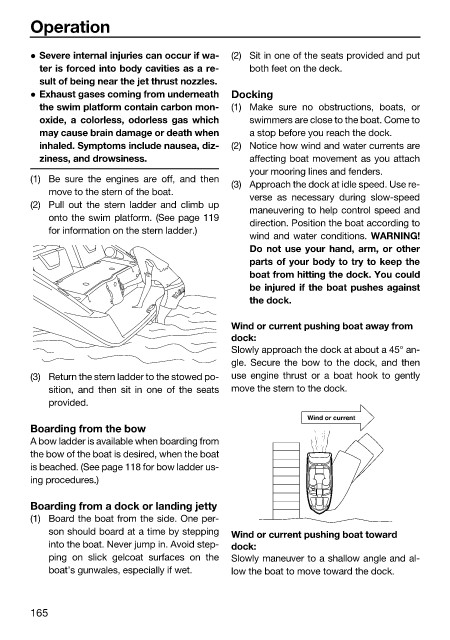
(1) Be sure the engines are off, and then
(3) Approach the dock at idle speed. Use re-
move to the stern of the boat.
verse as necessary during slow-speed
(2) Pull out the stern ladder and climb up
maneuvering to help control speed and
onto the swim platform. (See page 119
direction. Position the boat according to
for information on the stern ladder.)
wind and water conditions. WARNING!
Do not use your hand, arm, or other
parts of your body to try to keep the
boat from hitting the dock. You could
be injured if the boat pushes against
the dock.
Wind or current pushing boat away from
dock:
Slowly approach the dock at about a 45° an-
gle. Secure the bow to the dock, and then
(3) Return the stern ladder to the stowed po- use engine thrust or a boat hook to gently
sition, and then sit in one of the seats move the stern to the dock.
provided.
Wind or current
Boarding from the bow
A bow ladder is available when boarding from
the bow of the boat is desired, when the boat
is beached. (See page 118 for bow ladder us-
ing procedures.)
Boarding from a dock or landing jetty
(1) Board the boat from the side. One per-
son should board at a time by stepping Wind or current pushing boat toward
into the boat. Never jump in. Avoid step- dock:
ping on slick gelcoat surfaces on the Slowly maneuver to a shallow angle and al-
boat’s gunwales, especially if wet. low the boat to move toward the dock.
165

