


Page 122 - LIT-18626-14-72
P. 122
SportsBoat_F6H14.book Page 115 Thursday, August 17, 2023 4:57 PM
Operation
be injured if the boat pushes against Beaching
the dock. NOTICE
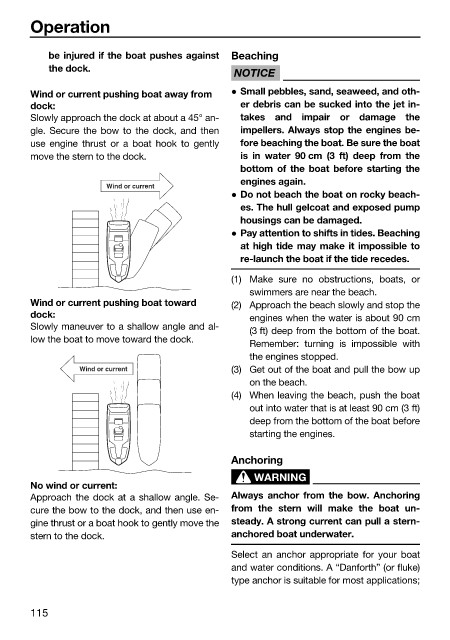
Wind or current pushing boat away from Small pebbles, sand, seaweed, and oth-
dock: er debris can be sucked into the jet in-
Slowly approach the dock at about a 45° an- takes and impair or damage the
gle. Secure the bow to the dock, and then impellers. Always stop the engines be-
use engine thrust or a boat hook to gently fore beaching the boat. Be sure the boat
move the stern to the dock. is in water 90 cm (3 ft) deep from the
bottom of the boat before starting the
engines again.
Wind or current
Do not beach the boat on rocky beach-
es. The hull gelcoat and exposed pump
housings can be damaged.
Pay attention to shifts in tides. Beaching
at high tide may make it impossible to
re-launch the boat if the tide recedes.
(1) Make sure no obstructions, boats, or
swimmers are near the beach.
Wind or current pushing boat toward (2) Approach the beach slowly and stop the
dock: engines when the water is about 90 cm
Slowly maneuver to a shallow angle and al-
(3 ft) deep from the bottom of the boat.
low the boat to move toward the dock.
Remember: turning is impossible with
the engines stopped.
Wind or current (3) Get out of the boat and pull the bow up
on the beach.
(4) When leaving the beach, push the boat
out into water that is at least 90 cm (3 ft)
deep from the bottom of the boat before
starting the engines.
Anchoring
WARNING
No wind or current:
Approach the dock at a shallow angle. Se- Always anchor from the bow. Anchoring
cure the bow to the dock, and then use en- from the stern will make the boat un-
gine thrust or a boat hook to gently move the steady. A strong current can pull a stern-
stern to the dock. anchored boat underwater.
Select an anchor appropriate for your boat
and water conditions. A “Danforth” (or fluke)
type anchor is suitable for most applications;
115

