


Page 194 - LIT-18626-13-49
P. 194
SportsBoat_F3R15.book Page 185 Friday, May 14, 2021 11:12 AM
Operation
Pay attention to shifts in tides. Beaching ter. For example, if you are anchoring in
at high tide may make it impossible to 10 feet of water, let out 40–60 feet of line.
re-launch the boat if the tide recedes. Secure the line.
(4) Pull on the line to be sure the anchor is
(1) Make sure no obstructions, boats, or
holding. Also, periodically check your
swimmers are near the beach.
boat’s position against the shoreline to
(2) Approach the beach slowly and stop the
make sure it is not drifting and dragging
engines when the water is about 90 cm
the anchor. Reset if necessary.
(3 ft) deep from the bottom of the boat.
(5) To pull in (“weigh”) the anchor, start the
Remember: turning is impossible with
engines and move forward, keeping ten-
the engines stopped.
sion on the line as you pull it in. When the
(3) Get out of the boat and pull the bow up
anchor line is straight up and down, pull
on the beach.
hard to lift the anchor from the bottom
(4) When leaving the beach, push the boat
material.
out into water that is at least 90 cm (3 ft)
(6) If the anchor is stuck on the bottom, try
deep from the bottom of the boat before
this: Let out a few feet of anchor line and
starting the engines.
secure the line to the boat, again. Slowly
maneuver the boat around the anchor
Anchoring
until the anchor pulls loose. Keep the line
WARNING taut during this procedure.
Always anchor from the bow. Anchoring
Crossing wakes and swells
from the stern will make the boat un-
You will not always have flat, smooth water.
steady. A strong current can pull a stern-
There will be swells and wakes from other
anchored boat underwater.
boats, etc.
Select an anchor appropriate for your boat The best way to cross wakes and swells is
and water conditions. A “Danforth” (or fluke) with the least jolt to you and the boat. Small
type anchor is suitable for most applications; swells are not as difficult to cross as larger
your Yamaha Boat Dealer can help you swells or wakes. Crossing a sharp wake gives
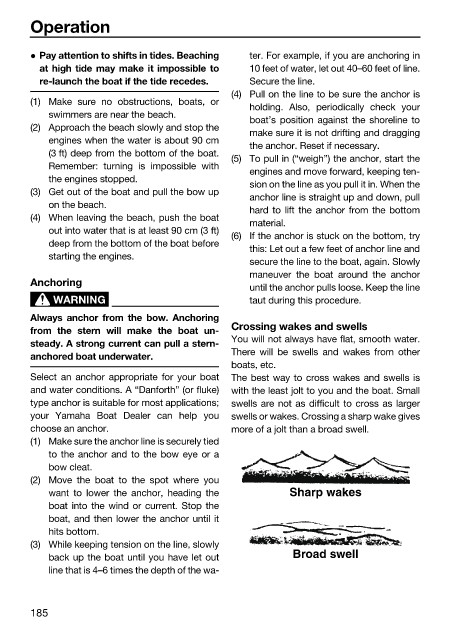
choose an anchor. more of a jolt than a broad swell.
(1) Make sure the anchor line is securely tied
to the anchor and to the bow eye or a
bow cleat.
(2) Move the boat to the spot where you
want to lower the anchor, heading the Sharp wakes
boat into the wind or current. Stop the
boat, and then lower the anchor until it
hits bottom.
(3) While keeping tension on the line, slowly
back up the boat until you have let out Broad swell
line that is 4–6 times the depth of the wa-
185

