


Page 126 - LIT-18626-13-46
P. 126
SportsBoat_F4X13.book  Page 119  Friday, May 21, 2021  4:49 PM


                        Operation

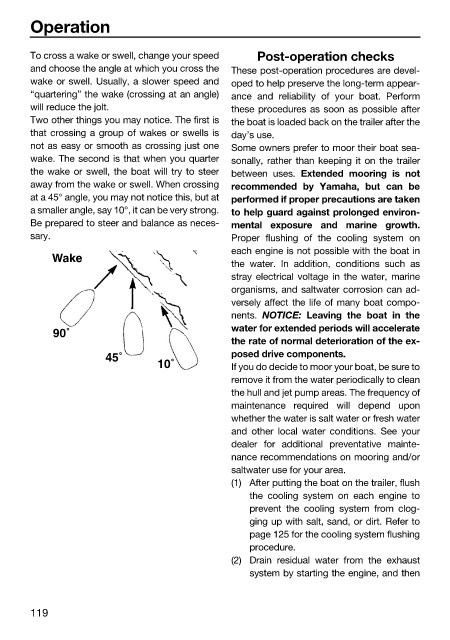
                        To cross a wake or swell, change your speed  Post-operation checks
                        and choose the angle at which you cross the  These post-operation procedures are devel-
                        wake or swell. Usually, a slower speed and  oped to help preserve the long-term appear-
                        “quartering” the wake (crossing at an angle)  ance and reliability of your boat. Perform
                        will reduce the jolt.                 these procedures as soon as possible after
                        Two other things you may notice. The first is  the boat is loaded back on the trailer after the
                        that crossing a group of wakes or swells is  day’s use.
                        not as easy or smooth as crossing just one  Some owners prefer to moor their boat sea-
                        wake. The second is that when you quarter  sonally, rather than keeping it on the trailer
                        the wake or swell, the boat will try to steer  between uses.  Extended mooring  is not
                        away from the wake or swell. When crossing  recommended by Yamaha, but can  be
                        at a 45° angle, you may not notice this, but at  performed if proper precautions are taken
                        a smaller angle, say 10°, it can be very strong.  to help guard against prolonged environ-
                        Be prepared to steer and balance as neces-  mental exposure and  marine  growth.
                        sary.                                 Proper flushing of the cooling system on
                                                              each engine is not possible with the boat in
                            Wake
                                                              the water. In addition, conditions  such  as
                                                              stray electrical voltage in the water, marine
                                                              organisms, and saltwater corrosion can ad-
                                                              versely affect the life of many boat compo-
                                                              nents.  NOTICE: Leaving the  boat in the
                                                              water for extended periods will accelerate
                            90˚
                                                              the rate of normal deterioration of the ex-
                                      45˚                     posed drive components.
                                                10˚           If you do decide to moor your boat, be sure to
                                                              remove it from the water periodically to clean
                                                              the hull and jet pump areas. The frequency of
                                                              maintenance required will depend upon
                                                              whether the water is salt water or fresh water
                                                              and other local water conditions. See your
                                                              dealer for additional  preventative mainte-
                                                              nance recommendations on mooring and/or
                                                              saltwater use for your area.
                                                              (1) After putting the boat on the trailer, flush
                                                                 the cooling system on each  engine to
                                                                 prevent the cooling  system from  clog-
                                                                 ging up with salt, sand, or dirt. Refer to
                                                                 page 125 for the cooling system flushing
                                                                 procedure.
                                                              (2) Drain residual water from the exhaust
                                                                 system by starting the engine, and then


                        119

