


Page 116 - LIT-18626-13-01
P. 116
SportsBoat_F6H10.book  Page 109  Tuesday, January 19, 2021  5:51 PM


                        Operation

                        (1) Make sure the anchor line is securely tied
                            to the anchor and to the bow eye or a
                            bow cleat.
                        (2) Move the  boat to  the spot where  you
                            want to lower the anchor, heading the        Sharp wakes
                            boat into the wind or current. Stop the
                            boat, and then lower the anchor until it
                            hits bottom.
                        (3) While keeping tension on the line, slowly
                            back up the boat until you have let out      Broad swell
                            line that is 4–6 times the depth of the wa-
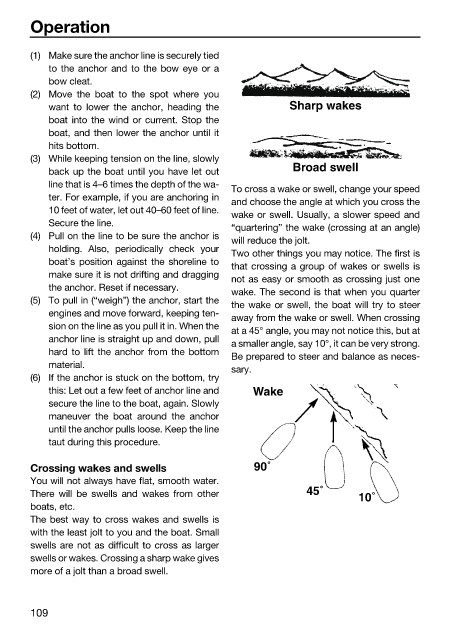
                                                              To cross a wake or swell, change your speed
                            ter. For example, if you are anchoring in
                                                              and choose the angle at which you cross the
                            10 feet of water, let out 40–60 feet of line.
                                                              wake or swell. Usually, a slower speed and
                            Secure the line.
                                                              “quartering” the wake (crossing at an angle)
                        (4) Pull on the line to be sure the anchor is
                                                              will reduce the jolt.
                            holding.  Also, periodically check  your
                                                              Two other things you may notice. The first is
                            boat’s position against the shoreline to
                                                              that crossing a group of wakes or swells is
                            make sure it is not drifting and dragging
                                                              not as easy or smooth as crossing just one
                            the anchor. Reset if necessary.
                                                              wake. The second is that when you quarter
                        (5) To pull in (“weigh”) the anchor, start the
                                                              the wake or swell, the boat will try to steer
                            engines and move forward, keeping ten-
                                                              away from the wake or swell. When crossing
                            sion on the line as you pull it in. When the
                                                              at a 45° angle, you may not notice this, but at
                            anchor line is straight up and down, pull
                                                              a smaller angle, say 10°, it can be very strong.
                            hard to lift the anchor from the bottom
                                                              Be prepared to steer and balance as neces-
                            material.
                                                              sary.
                        (6) If the anchor is stuck on the bottom, try
                            this: Let out a few feet of anchor line and  Wake
                            secure the line to the boat, again. Slowly
                            maneuver the boat around the anchor
                            until the anchor pulls loose. Keep the line
                            taut during this procedure.
                        Crossing wakes and swells                 90˚
                        You will not always have flat, smooth water.
                        There will  be  swells and wakes from other         45˚      10˚
                        boats, etc.
                        The best way to cross wakes and swells is
                        with the least jolt to you and the boat. Small
                        swells are not as difficult to cross as larger
                        swells or wakes. Crossing a sharp wake gives
                        more of a jolt than a broad swell.


                        109

